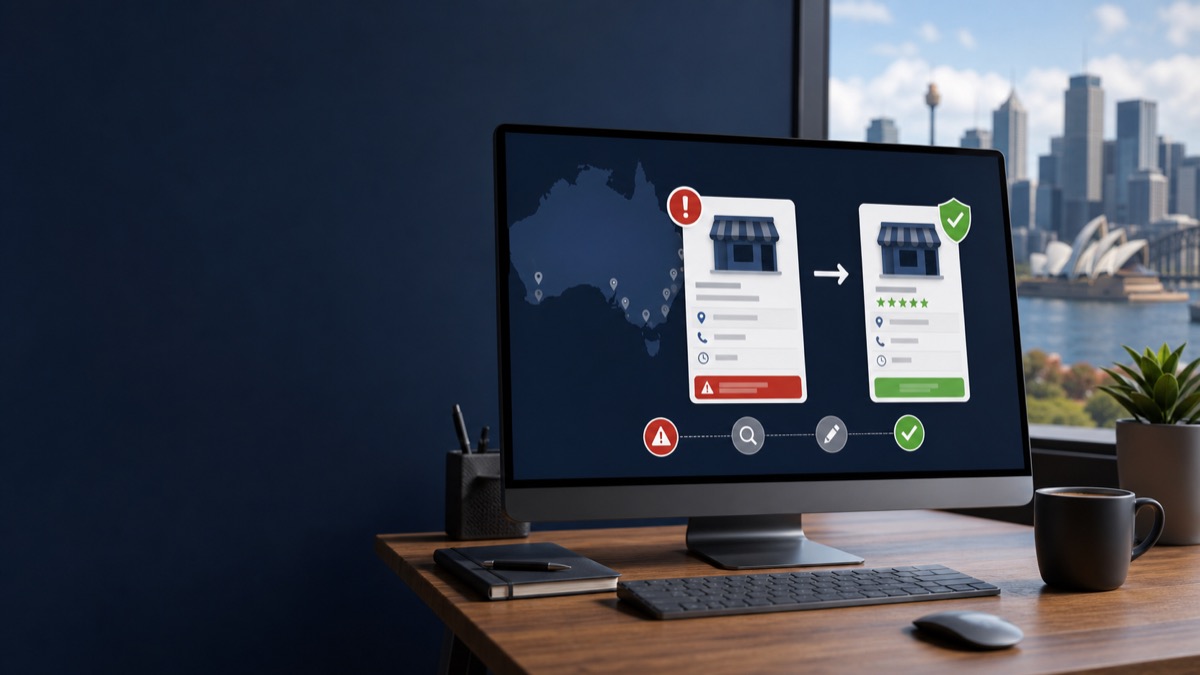
If your Google Business Profile is suspended in the UK, the fastest route back is one appeal, supported by documents whose name and address match your listing exactly. Companies House records are the strongest evidence a UK business has, and they are also the records most likely to contradict a listing without the owner realising.
You get one submission. What follows is how to make it count.
Why do UK Google Business Profiles get suspended?
The rules are global, not local. Google applies the same guidelines to a plumber in Leeds as it does to one in Los Angeles, and the same three failures account for most suspensions.
Google's guideline on naming is strict: "Your name should reflect your business's real-world name," and it bans marketing taglines, service descriptions, location details, phone numbers, URLs, and fully capitalised words. Unnecessary information in the name "could result in the suspension of your Business Profile." [Source: Google Business Profile Help, Guidelines for representing your business on Google, 2026]
Two UK habits collide with this directly:
- Adding the town to the trading name. "Barnes Electrical Manchester" is a location detail in the name field, and it is a violation even when the business genuinely only serves Manchester.
- Adding Ltd when the signage does not. Google allows legal terms only where "you must provide real-world proof (e.g. signage, business cards, invoices)." A listing reading "Barnes Electrical Ltd" against a van that says "Barnes Electrical" is a mismatch a reviewer can see.
The third failure is the address. Google states that "P.O. boxes or mailboxes located at remote locations aren't acceptable," virtual offices are not eligible, and businesses showing an address must "maintain permanent fixed signage of their business name at the address." Registered-office services sold by UK accountants fall straight into the virtual office category.
What proof does Google accept from a UK business?
Google names the document types it will look at, and the matching requirement matters more than the documents themselves.
Acceptable evidence includes business registration, a business licence, tax certificates, and utility bills. The business name and address on each document "should match the profile." [Source: Google Business Profile Help, Fix a suspended Business Profile, 2026]
For a UK limited company, that maps onto:
| Google's category | UK equivalent |
|---|---|
| Business registration | Companies House certificate of incorporation, or confirmation statement |
| Business licence | Sector licence: FCA, Gas Safe, SIA, local authority premises licence |
| Tax certificate | VAT registration certificate, or HMRC correspondence |
| Utility bill | Business energy, water, or business rates bill for the premises |
Sole traders have no Companies House record. The usable substitutes are an HMRC Unique Taxpayer Reference letter, a business bank statement, a business rates bill, and public liability insurance showing the trading name and address. Our reinstatement evidence checklist works through what a strong package looks like in each case.
Does your Companies House record match your listing?
This is the check most UK businesses skip, and it is the one that decides appeals.
Every UK company must file a confirmation statement at least once every 12 months, including dormant and non-trading companies. Before filing it, you must report changes to your directors, secretary, people with significant control, registered office address, and registered email address. Filing costs £50 online or £110 on a paper CS01, and failing to file can lead to a fine of up to £5,000 and possible striking off. [Source: GOV.UK, Confirmation statement guidance, Companies House]
The trap is the registered office address. Thousands of UK companies use their accountant's address as the registered office while trading from somewhere else entirely. That is lawful and normal. It is also a direct contradiction between your Companies House record and your Google listing, and if you submit the confirmation statement as proof, you have handed Google a document that disagrees with the address you are trying to defend.
Three positions, and what each one needs:
| Your situation | What to submit |
|---|---|
| Registered office is your trading address | Confirmation statement, straightforward |
| Registered office is your accountant's | Do not lead with Companies House. Use a business rates bill or utility bill for the trading address |
| Service-area business working from home | Hide the address, submit insurance and a vehicle livery photograph |
Check your record at Companies House before you submit anything. If the registered office and the trading address differ, say so in the appeal rather than letting a reviewer find it.
Google Business Profile suspended UK: the appeal, step by step
The sequence matters because one step, taken in the wrong order, consumes your only attempt.
Google's rule is explicit: appeals "can only be submitted once," and you should not create a new profile for the same business while one is pending. If a request is denied, you may be able to request an additional review with new evidence. [Source: Google Business Profile Help, Fix a suspended Business Profile, 2026]
- Identify what is actually suspended. Google separates a profile suspension from an account restriction. A restricted account suspends every profile it manages and blocks you from claiming others. The restriction has to be appealed first, on the My accounts page, before the profile appeal is possible. If you cannot see an appeal option at all, our guide to the appeals tool not working explains which of the two you are facing.
- Fix the violation before appealing. Google asks you to confirm the profile meets the guidelines first. Appealing an unfixed listing wastes the submission. Run a suspension risk audit across the name, address and service-area settings.
- Assemble documents that agree with each other. Same trading name, same address, on every file. A single mismatch between the utility bill and the listing is enough.
- Submit once, with a short factual explanation of what the business does and where it operates.
- Change nothing while you wait. Edits during a review restart it.
If the answer comes back no, that is not the end. The additional review route exists specifically for denied appeals with new evidence, and it is a different process from the first appeal.
Do UK businesses get the EEA appeal route?
No, and this is worth knowing before you go looking for an escalation path that does not apply to you.
Google's suspension page states that users in the EEA may have extra redress options. [Source: Google Business Profile Help, Fix a suspended Business Profile, 2026] The UK is not in the EEA. It ceased to be a contracting party to the EEA Agreement on leaving the EU, and the transition period during which EEA treatment continued ended on 31 December 2020. The UK has been a third country under that agreement since.
The practical effect is that a UK business has the standard appeal and the additional review, and should not spend time hunting for the EU-specific redress mechanisms that Irish, German, or Dutch businesses can reach. Advice written for an EU audience will point at options you do not have.
Businesses in Australia face a similar position, and our Australian reinstatement guide covers the same ground for that market.
How GBP Case helps
We prepare the appeal package before anything is submitted, because the submission does not come back.
For UK businesses that means reading the listing against Google's guidelines, pulling the Companies House record, and checking every document against the profile for the mismatches that get appeals refused. Where the registered office and trading address differ, we build the package around the evidence that supports the trading address instead of the evidence that contradicts it.
If your profile is down now, start at reinstatement. If an appeal has already been refused, the appeal denied page is the right entry point, and it is a genuinely different problem from a first suspension.
Frequently asked questions
How long does a UK Google Business Profile appeal take?
Google publishes no timeframe. Its own page says only that it will review the appeal and email you the decision, so any specific number of days you read elsewhere is someone's estimate rather than a Google commitment. Plan around the uncertainty instead of the estimate. Keep trading, keep taking calls on the number listed, and do not edit the profile while the review is open. Editing restarts it. If you need the listing back by a fixed date, that pressure should go into preparing better evidence, not into chasing the queue.
Can I use my accountant's registered office address on my Google listing?
No. Google requires the profile to describe your actual, real-world location, and it excludes virtual offices. A registered office service is a virtual office for Google's purposes, however legitimate it is under UK company law. If you trade from premises, list the premises. If you have no premises and travel to customers, set up as a service-area business, hide the address, and keep the service area inside the limit Google sets. Our service-area suspension guide covers the proof that setup needs.
My business name legally includes Ltd. Why is that a problem?
It is only a problem when your real-world presence does not show it. Google permits legal terms in the name where you can provide real-world proof such as signage, business cards, or invoices. If your shopfront, van, and invoices all read "Barnes Electrical Ltd", keep it and photograph the proof. If they read "Barnes Electrical", match the listing to them. The listing is meant to reflect how customers encounter the business, not how it appears on the register.
Does being suspended for suspicious activity change the approach?
The evidence bar is higher and the message is vaguer, but the process is the same. Suspicious activity is the label Google applies when its systems flag a pattern rather than a specific breach, so you are proving the business is real and operating rather than rebutting one named violation. That makes documents showing continuous trading more valuable: rates bills, insurance, bank statements across several months. We cover it in detail in the suspicious activity guide.
The short version
Google applies global rules to UK listings, and the UK does not get the EEA redress route. That leaves one appeal and one additional review if the first is refused.
The decisive factor is whether your documents agree with your listing. For UK companies the usual point of failure is a Companies House registered office that is not the trading address, submitted as proof and quietly undermining the case.
Check that one thing before you appeal. If you would rather have it checked properly, tell us about your profile.
Need Help With Your Suspension?
Start with a free consultation and clear case pricing before you decide. We review the issue and explain the recovery path.
Get my free case review